
Beginning Writing Doesn't Start with Writing Part 2
Writing Is Developmental
When I started asking a different question—What has to happen before writing becomes successful?—I found myself looking at writing in a completely different way.
The more I studied child development, the more I realized something that now seems incredibly obvious.
We already understand that reading is developmental.
No one expects a child to read a chapter book before learning letter names and sounds. We don't skip phonological awareness and move straight to decoding. We don't expect fluent reading before students learn to blend words.
Every reading skill builds on the one before it.
Every stage prepares students for the next.
We honor that progression because we know children can't skip developmental steps.
So why don't we think about writing the same way?
Somewhere along the way, we've started treating writing as though it's a task instead of a developmental process. We assume that if students have something to say, they should be able to write it.
But saying an idea and writing an idea are two completely different things.
One lives almost entirely in language.
The other requires language, motor development, phonological awareness, spelling, letter formation, executive functioning, working memory, and attention—all working together at the same time. The gap between those two things is much larger than we often realize.
I think writing has become a victim of its own success. When we watch an adult write, it looks effortless. Ideas flow. Letters are automatic. Spelling happens almost unconsciously. We don't stop to think about each tiny decision because we've practiced those skills for decades. Young children don't experience writing that way. For them, every letter requires thought. Every word requires problem-solving. Every sentence demands decisions.
"Where do I start?"
"What sound do I hear?"
"How do I make that letter?"
"Did I leave a space?"
"What comes next?"
Have you ever watched a child spend so much energy trying to remember how to make the letter g that they completely forgot what they wanted to say?
I have.
And that's when I realized something important.
Those foundational skills aren't getting in the way of writing.
They are writing.
The more automatic handwriting, spelling, and encoding become, the more mental energy children have available for thinking, creating, and communicating. That's exactly why researchers like Louisa Moats emphasize explicit instruction in handwriting and spelling. Automaticity isn't about beautiful penmanship. It's about freeing the brain to think. That realization completely shifted my perspective.
I stopped viewing handwriting as something separate from writing.
I stopped viewing spelling as something separate from writing.
I stopped viewing phonics as something separate from writing.
Instead, I started seeing them as essential parts of the same developmental journey.
The more I observed children, the more I realized something else.
Writing actually begins long before conventional writing appears on paper.
It begins in conversation.
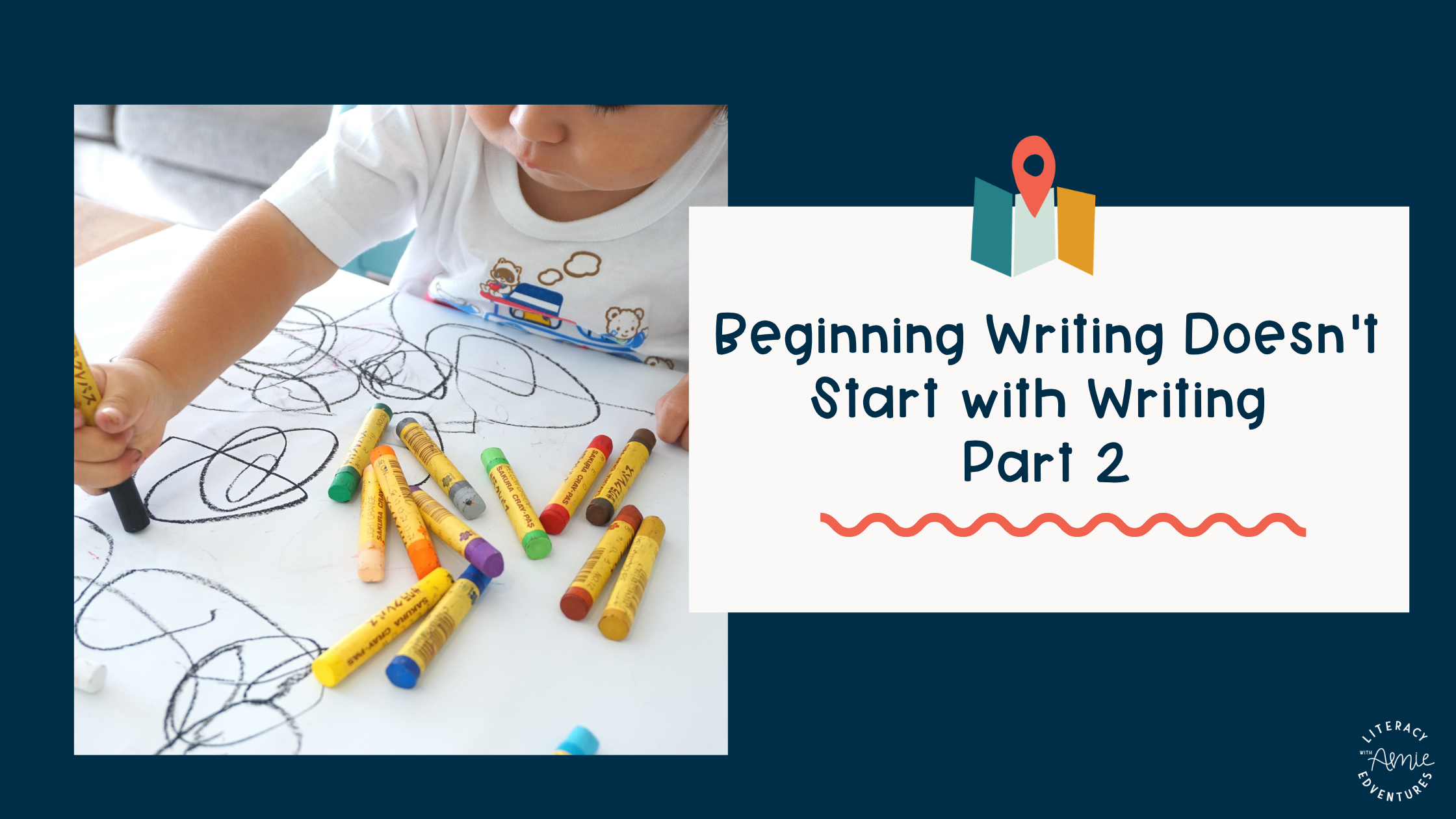
Think about toddlers for a moment. Long before they ever hold a crayon, they're already learning that communication has meaning. They point. Gesture. Babble. Ask questions. Tell stories. They're building language every single day. Then something amazing begins to happen. Children start assigning meaning to symbols. A page full of scribbles suddenly becomes a birthday card for Grandma. A series of circles becomes a grocery list. A page of zigzags becomes an elaborate story that only the child can "read." As adults, we often smile because it's adorable. Researchers smile because they recognize what's happening. Those aren't random marks. They're the earliest stages of writing. Children are discovering one of literacy's biggest ideas:
Marks on a page can carry meaning.
That understanding comes long before conventional spelling. Long before beautiful handwriting and well before complete sentences.
And yet...
How often have we heard someone say,
"Stop scribbling."
"Draw less."
"We need real writing now."
I've said those things before.
Maybe you have too.
But what if scribbling isn't getting in the way of writing? What if it's actually preparing children for writing? When children scribble, they're strengthening muscles, developing control, experimenting with movement, learning directionality, and most importantly, discovering that written marks communicate meaning. They're becoming writers. That doesn't mean children should stay in that stage forever. Development always moves forward. But every developmental stage deserves to be honored rather than hurried.
I think this is where many beginning writing programs unintentionally create frustration.
Students are often asked to produce sentences before they've been intentionally taught all the skills that make sentence writing possible. It's a little like asking children to solve multiplication problems before they've developed number sense.
The task itself isn't inappropriate.
The sequence is.
I think this is where so many teachers find themselves stuck—not because they don't know how to teach, not because they aren't working hard enough, and certainly not because they don't care about their students.
They're doing exactly what they've been asked to do.
They're following the curriculum they've been given: a curriculum that asks students to write personal narratives, informational pieces, responses to reading, and complete paragraphs. So teachers do what great teachers have always done. They model writing. They confer with students. They provide sentence starters, create anchor charts, pull small groups, and encourage reluctant writers. They work tirelessly to help every child be successful.
And yet, so many children still struggle.
I don't think that's because teachers are doing anything wrong. I think it's because many writing curricula begin at the destination rather than at the beginning of the journey. They tell us what students should produce, but they don't always show us how young children develop the skills needed to produce it. Those are two very different things.
As teachers, we often feel caught in the middle. We know what the curriculum expects, and we know where our students are. Sometimes those two places feel miles apart. If you've ever looked at a writing lesson and quietly thought, "My students aren't ready for this yet," you're not imagining it. You aren't lowering expectations—you are recognizing development.
That realization gave me tremendous peace.
Instead of feeling like I was failing my students because they weren't meeting the curriculum's expectations, I began to realize that many of them simply hadn't experienced the developmental steps that make those expectations possible. The issue wasn't that they couldn't learn to write. It was that we were asking them to do something before we had intentionally built the foundation it required.
That realization changed the questions I asked.
Instead of asking, "How do I get my students to meet the curriculum?" I began asking, "What experiences do my students need before they'll be successful with the curriculum?"
That single shift transformed my teaching.
I wasn't replacing the curriculum.
I was building the bridge that helped students reach it.
That distinction matters because it changes where we spend our energy. When we believe the task itself is the problem, we search for better prompts, more engaging writing topics, or another graphic organizer that might finally make writing click. But when we realize the sequence is the problem, our focus shifts. We stop searching for another activity and start building stronger foundations instead.
The more I reflected on all of this, the more convinced I became that writing instruction didn't need another curriculum.
It needed a roadmap.
A developmental roadmap that respects how children actually learn. One that recognizes every stage has value and intentionally prepares students for the next step instead of assuming they'll simply figure it out along the way.
Because here's what I've come to believe.
Children don't become writers overnight. They become writers one developmental step at a time. Every conversation prepares them for storytelling. Every story prepares them for drawing. Every drawing prepares them for symbols. Every symbol prepares them for letters. Every letter prepares them for words. Every word prepares them for sentences. Every sentence prepares them for connected writing. Every connected idea prepares them for authentic communication.
Nothing is wasted.
Nothing is random.
Every step matters.
Once I understood that, I stopped asking, "When should my students start writing?" Instead, I started asking a much better question: Where is this child on the developmental journey, and what's the next step?
That question transformed my teaching because once you understand how writing develops, you stop guessing what to teach next. You stop feeling like you're constantly trying to catch students up. Instead, you simply keep moving them forward—one intentional step at a time.
But what does that developmental journey actually look like?
If writing develops one step at a time...
What are those steps?
That's exactly what we'll explore in Part 3.
Because once I could finally see the progression, I stopped feeling like I was piecing writing instruction together.
I finally had the roadmap I'd been searching for.